
AI Marketing Automation for Small Businesses
How BROSH AI CRM Helps Small Teams Attract, Nurture, and Convert More Customers
Last modified by Ben Ford, on Fri Jul 24 2026 11:46:46 GMT-0500 (Central Daylight Time)
AI Marketing Automation for Small Businesses
Marketing is essential for small-business growth, but it can also consume a significant amount of time. Business owners and employees may spend hours writing emails, updating contact records, following up with leads, preparing campaigns, scheduling tasks, and trying to understand which marketing activities are producing results.
AI marketing automation helps small businesses perform more of this work intelligently and consistently. Instead of relying on disconnected spreadsheets, manual reminders, and repeated administrative work, a business can use AI and automation to manage customer communication, organize leads, personalize outreach, and keep opportunities moving forward.
BROSH AI CRM combines customer relationship management, marketing automation, sales tools, and AI-powered employees in one platform. It gives small businesses a practical way to use AI without needing a large marketing department or a complicated collection of separate tools.
What Is AI Marketing Automation?
Marketing automation uses software to perform repeatable marketing tasks based on schedules, customer behavior, CRM data, or predefined business rules. Artificial intelligence adds another layer by helping businesses interpret information, generate content, personalize communication, and decide what action may be appropriate next.
For example, when a potential customer submits a form, an automated system can create a CRM record, assign the lead, send an acknowledgment, schedule a follow-up task, and begin a relevant email sequence.
AI can make this process more useful by drafting a personalized response, summarizing the customer's request, suggesting the next action, or helping categorize the opportunity based on the available information.
This allows the business to respond more quickly while still maintaining a personal and relevant customer experience.
Why Small Businesses Need Marketing Automation
Small businesses often operate with limited time and limited staff. The same person may be responsible for sales, marketing, customer service, administration, and business operations. As the number of leads and customers increases, important follow-ups can easily be delayed or forgotten.
Without automation, employees may repeatedly perform tasks such as:
- Copying website leads into a spreadsheet or CRM
- Sending similar welcome emails manually
- Remembering when to follow up after a quotation
- Updating contact and opportunity records
- Preparing lists for email campaigns
- Checking which customers have not responded
- Creating marketing content and message variations
- Reviewing campaign results across several systems
Each task may appear small, but together they consume valuable time and create opportunities for mistakes. Marketing automation gives the business a repeatable process that continues working even when the team is busy.
It also helps create a more consistent customer experience. Every lead can receive an initial response, every important opportunity can have a next step, and every employee can work from the same customer history.
How AI Improves Traditional Marketing Automation
Traditional automation normally follows fixed rules. For example, if a lead completes a form, the system sends a predefined email. This is useful, but it may not consider the customer's exact question, industry, previous activity, or level of interest.
AI can analyze the information available in the CRM and help create a more relevant response. It can summarize conversations, identify key details, recommend content, draft follow-up messages, and help employees understand the status of an opportunity more quickly.
AI can also support marketing teams by producing first drafts for:
- Marketing emails
- Lead follow-up messages
- Social media posts
- Campaign descriptions
- Product and service summaries
- Customer re-engagement messages
- Sales proposals and introductory content
Employees can then review and adjust the content before it is delivered. This reduces the time required to begin a campaign while keeping the business in control of its message.
How BROSH AI CRM Supports Marketing Automation
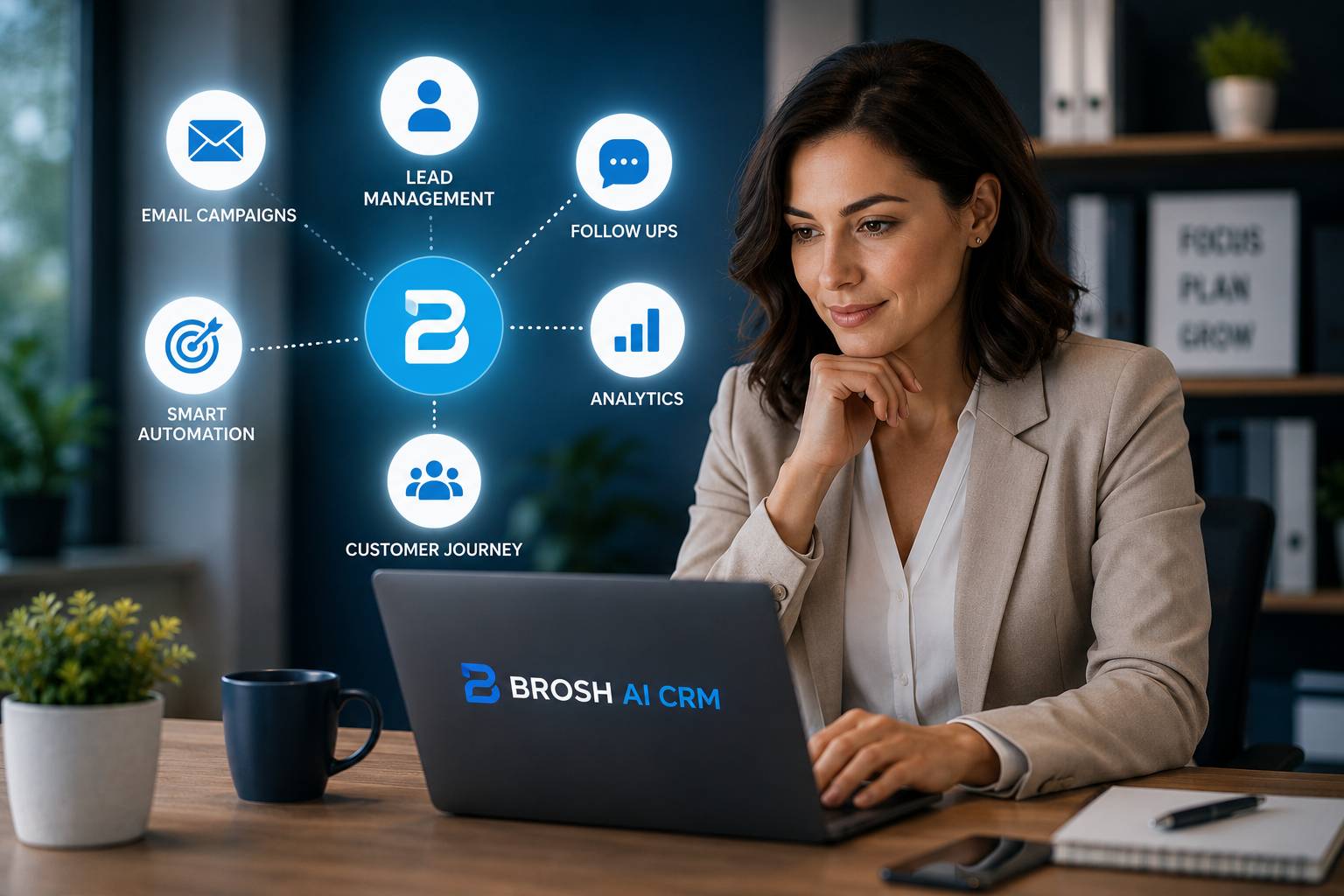
BROSH AI CRM gives small businesses a central platform for managing contacts, leads, sales opportunities, campaigns, projects, tasks, and customer communication. Marketing activity is connected directly to the customer record, helping the team understand the complete relationship instead of viewing isolated messages.
The platform can help businesses organize leads from different sources, maintain accurate customer data, schedule activities, automate communication, and monitor opportunities as they move through the sales process.
BROSH AI CRM can support marketing automation in several practical ways.
1. Centralized Lead and Customer Management
Marketing automation is most effective when customer information is organized. BROSH AI CRM stores contact details, communication history, opportunities, tasks, notes, documents, and activities in one place.
This gives the business a clear view of each lead. Employees can see where the lead came from, what the customer requested, which messages were sent, and what should happen next.
Centralized information also reduces duplicated work. Employees do not need to search across personal inboxes, spreadsheets, messaging apps, and handwritten notes to understand the customer relationship.
2. Automated Lead Follow-Up
A new lead can lose interest quickly when there is no response. BROSH AI CRM helps businesses create structured follow-up processes so that new inquiries receive attention and existing opportunities do not disappear from view.
The business can create tasks, reminders, scheduled messages, and automated actions based on the lead's status or activity. For example, a follow-up can be scheduled after a quotation, a demonstration, an introductory call, or a period without a response.
This creates consistency while allowing employees to focus their personal attention on conversations that require judgment or relationship-building.
3. AI-Assisted Email Marketing
BROSH AI CRM can help small businesses prepare marketing and sales emails more efficiently. AI can assist with drafting messages, summarizing customer needs, and creating suitable follow-up content.
Because the communication is connected to CRM data, the business can divide customers into relevant groups and send more focused messages. Different campaigns can be prepared for new leads, existing customers, inactive contacts, previous buyers, or prospects interested in a particular service.
This is more effective than sending the same generic email to every contact.
4. Customer Segmentation
Not every customer should receive the same campaign. A new lead may need educational information, while an existing customer may be more interested in an upgrade, renewal, or complementary service.
BROSH AI CRM helps businesses organize contacts using CRM fields, categories, activities, sales stages, interests, and other business information. These segments can then be used to create more relevant marketing lists and campaigns.
Better segmentation can improve engagement and reduce the number of irrelevant messages customers receive.
5. Automated and Scheduled AI Employees
One of the major advantages of BROSH AI CRM is the ability to use AI-powered employees for scheduled and repeatable business processes. These AI agents can support activities across sales, marketing, customer service, scheduling, and data management.
Depending on the business process and approved permissions, an AI employee can help review CRM information, identify records requiring attention, prepare responses, enrich data, update records, or assist with follow-up activities.
For a small business, this can provide additional operational capacity without requiring every administrative task to be completed manually.
The purpose is not to remove human involvement from important customer relationships. Instead, the AI employee handles or assists with repetitive work so that people can focus on strategy, service, sales, and customer relationships.
6. Data Enrichment and Better Customer Profiles
Effective marketing depends on accurate and complete data. Missing company names, industries, contact details, or customer classifications can make campaigns less useful.
BROSH AI CRM can assist with data enrichment and importing information into the CRM. Better customer profiles can help the business create more focused campaigns, prioritize promising leads, and prepare more relevant communication.
AI can also help summarize information so employees can understand a contact or company more quickly before making a call or sending a message.
7. Sales and Marketing Alignment
Marketing should not end when a lead is created. The sales team needs to know which campaign generated the lead, what information the prospect received, and what activity has already taken place.
Because BROSH AI CRM connects marketing activity with sales records, employees can move from initial interest to qualification, quotation, negotiation, and closing without losing the history of the relationship.
This helps reduce the gap between marketing and sales. Everyone works from the same information, and each lead can have a clear owner and next action.

Examples of AI Marketing Automation for Small Businesses
AI marketing automation can be applied to many common customer journeys. The following examples show how a small business can create more consistent processes.
Website Lead Follow-Up
A visitor completes a website form requesting information. The lead is added to BROSH AI CRM, assigned to the appropriate employee, and given a follow-up task. An acknowledgment can be sent immediately while the AI assists with preparing a personalized reply based on the inquiry.
Quotation Follow-Up
After a quotation is sent, the CRM schedules a reminder. If the customer does not respond, the business can send a helpful follow-up message, offer to answer questions, or invite the customer to schedule a call.
Customer Re-Engagement
The business can identify customers or leads who have not interacted for a defined period. A re-engagement campaign can introduce a new service, share useful information, or ask whether the customer's needs have changed.
Appointment and Demonstration Scheduling
Marketing messages can direct interested prospects toward an appointment or product demonstration. The CRM records the activity, schedules the next step, and keeps the sales opportunity connected to the original campaign.
Post-Purchase Communication
Automation can continue after the sale. The business can send onboarding information, request feedback, provide service reminders, or introduce related products and services at an appropriate time.
Customer Support as a Marketing Opportunity
Customer service affects retention, referrals, and reputation. BROSH AI employees can help manage support questions, organize customer information, and escalate issues that require personal attention.
A customer who receives responsive and well-organized service is more likely to remain loyal and recommend the business to others.
Benefits of AI Marketing Automation
When implemented correctly, AI marketing automation can help a small business:
- Respond to new leads more quickly
- Reduce repetitive administrative work
- Create more consistent follow-up processes
- Personalize marketing communication
- Organize customer information in one system
- Improve coordination between marketing and sales
- Identify leads and customers requiring attention
- Produce content and message drafts more efficiently
- Track customer activity and campaign results
- Scale operations without immediately expanding the team
These improvements can help the business generate more value from its existing leads and customer relationships. Instead of focusing only on increasing advertising expenditure, the business can improve how it manages the opportunities it already receives.
AI Automation Should Still Feel Human
Customers do not want to feel like anonymous records inside an automated system. Successful AI marketing automation should make communication more relevant and responsive, not less personal.
Businesses should review automated content, maintain accurate customer preferences, respect communication permissions, and provide an easy path to a human employee when personal assistance is needed.
AI is most valuable when it supports the customer relationship. It can perform repetitive work, highlight important information, and help employees respond faster, while people continue to provide judgment, empathy, creativity, and trust.
How to Start With AI Marketing Automation
Small businesses do not need to automate every process at once. A practical approach is to begin with one area where delays or repeated work are already creating problems.
A business might begin by automating:
- The first response to a new lead
- Follow-up reminders after quotations
- A welcome sequence for new customers
- Re-engagement messages for inactive leads
- Customer data enrichment
- Appointment scheduling
- Routine support or frequently asked questions
After the first process is working reliably, the business can add additional workflows and AI-supported tasks. Starting gradually makes it easier to measure the results and keep the customer experience under control.
Choosing an AI Marketing Automation Platform
Many automation platforms solve only one part of the problem. A business may use one tool for email marketing, another for sales, another for scheduling, another for customer service, and another for AI content.
This can create fragmented customer data and additional subscription costs. Employees may need to move between several systems just to understand one customer relationship.
BROSH AI CRM is designed to provide an integrated alternative. Customer records, sales opportunities, marketing activities, projects, communication, automation, and AI employees can work within the same business platform.
This unified approach gives small businesses better visibility and makes it easier to create automation based on real CRM information.
Turn Marketing Activity Into Measurable Business Growth
The purpose of marketing automation is not simply to send more emails or generate more content. The purpose is to create a dependable process that turns attention into conversations, conversations into opportunities, and opportunities into long-term customers.
BROSH AI CRM helps small businesses connect AI marketing automation with the complete customer journey. Leads can be organized, communication can be tracked, follow-ups can be scheduled, customer data can be enriched, and AI employees can assist with repeatable tasks.
This gives small teams the tools to operate more efficiently while maintaining the personal service that makes small businesses valuable.
AI marketing automation is no longer limited to large organizations with large marketing departments. With a practical AI-powered CRM, small businesses can create smarter processes, improve customer engagement, and build a more scalable foundation for growth.
Automate Your Marketing With BROSH AI CRM
Manage leads, personalize customer communication, automate follow-up, enrich CRM data, and launch AI-powered employees from one integrated business platform.
Explore BROSH AI CRM