
AI disclosure rules are now a customer-workflow issue
AI Transparency CRM: Keep B2B Customer Messages Trustworthy
Review AI-assisted messages, preserve human approval, record disclosure decisions, and keep every quote, promise, document, and follow-up grounded in trusted customer evidence.
Last modified: August 31, 2026
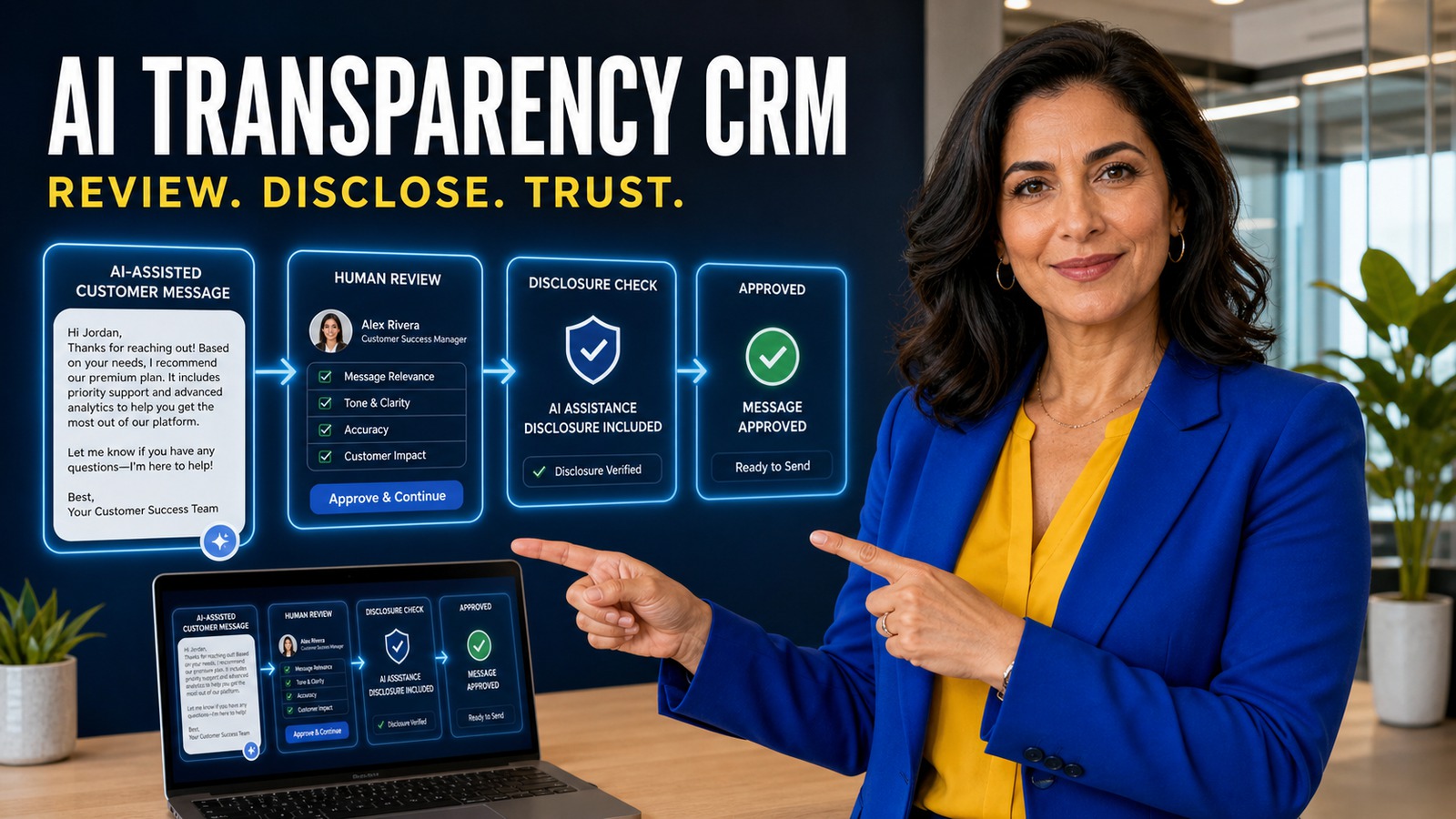

Inventory Every AI-Assisted Customer Touchpoint
AI now drafts emails, summarizes calls, proposes follow-ups, answers chat questions, and explains quotes. The risk is not simply that a tool is used. The risk is losing track of where it shaped a customer-facing decision.
Article 50 transparency obligations under the EU AI Act began applying on August 2, 2026. The European Commission says people should be informed when they interact directly with certain AI systems, while additional marking and disclosure duties apply to specified synthetic content.
Do not turn that into a vague “AI used” checkbox. Build a practical inventory around the customer journey and the actual message.
Map the touchpoints that can change trust
- chatbots and automated customer-service conversations;
- AI-assisted prospecting and follow-up emails;
- meeting summaries copied into customer records;
- quote explanations, pricing notes, and approval requests;
- contract, document, or proposal drafts;
- account recommendations and next-action suggestions;
- public-facing text, images, audio, or video.
For each touchpoint, record the business purpose, customer audience, tool or process owner, source data, review requirement, disclosure rule, approval state, and retained evidence.
Use one clean account identity before adding controls. BROSH bulk merge helps prevent the same buyer from receiving inconsistent messages across duplicate records.
Inventory test: a manager can see which active customer workflows use AI assistance, which ones interact directly with people, and who owns the final message.
Build Human Approval Gates Around Commercial Risk
An AI draft can sound fluent while using the wrong customer facts, outdated quote terms, or an unapproved promise. Human review should match the commercial consequence, not the length of the message.
Use four approval gates
- Evidence gate: verify customer facts, source notes, dates, product details, and open tasks.
- Commercial gate: confirm pricing, quote version, delivery terms, approval limits, and commitments.
- Transparency gate: decide whether the interaction or content needs disclosure, labelling, or machine-readable marking.
- Human release gate: assign an authorized reviewer and record the final version.
The Commission’s guidelines explain that responsibilities differ between providers and deployers and include practical examples and exceptions. That is a reason to document the decision path, not to guess from a generic template.
Create a clear escalation route for uncertain cases. A routine meeting-summary cleanup is different from an interactive customer bot, a public-interest publication, or synthetic media. Qualified legal or compliance advice may be needed for applicability.
Link the approved message to its active quote, document, and customer task. Use BROSH e-signature documents when customer acceptance or a signed commercial record matters.
Write a review task that can close
A weak task says “check AI email.” A strong task says: “Verify renewal quantity against quote version 4, remove the unsupported delivery promise, confirm whether the chatbot disclosure appears before interaction, and approve by Tuesday.”
Release test: the reviewer can explain what was checked, which evidence was used, what changed, whether disclosure was required, and who authorized sending.

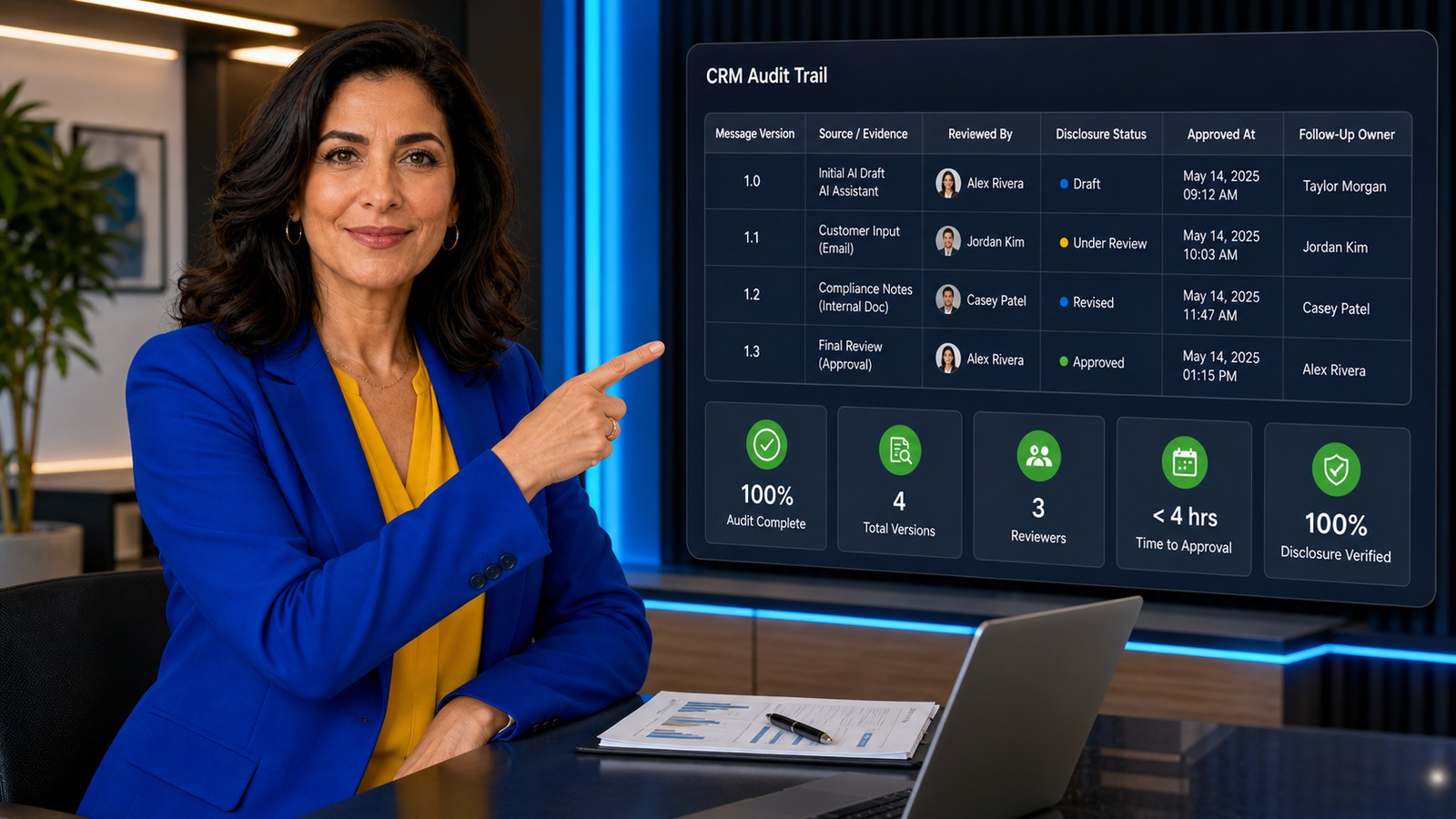
Preserve an Audit Trail Without Slowing Sales
Trust improves when teams can reconstruct a customer message quickly. Keep the audit trail compact enough for daily use and complete enough for a manager, reviewer, or customer concern.
Record seven pieces of evidence
- the customer-facing version that was approved;
- the prompt, instruction, or workflow type when relevant;
- the customer and source records used;
- the reviewer, approval time, and material edits;
- the disclosure or labelling decision and rationale;
- the quote, document, approval, or commitment linked to the message;
- the delivery channel, recipient, follow-up owner, and due date.
Retain evidence by risk. Teams do not need to archive every minor spelling correction forever. They do need reliable traceability when AI assistance can affect price, scope, deadlines, customer rights, regulated statements, or public trust.
OECD’s 2026 SME survey found AI adoption rising rapidly while strategic, targeted, and secure integration remains uneven. A lightweight CRM control closes that gap: it makes ownership, review, evidence, and next action part of the work itself.
Schedule overdue review and disclosure checks with BROSH CRM scheduling. Track promises created by AI-assisted messages through the customer commitments workflow.
Manage exceptions by customer impact
- pause a message when the evidence conflicts with the active record;
- escalate unapproved price, scope, or delivery commitments;
- replace expired documents before customer release;
- correct a missing disclosure before the next interaction;
- notify the account owner when a sent message needs clarification.
Audit test: the team can retrieve the approved message, its evidence, reviewer, disclosure decision, and owned follow-up in minutes.
Use an AI Customer Communication Control Table
Define the control, evidence, owner, and release condition before adding automation. Adapt the workflow to the relevant jurisdiction, use case, customer contract, and qualified advice.
| Control point | CRM evidence | Owner action | Ready when |
|---|---|---|---|
| Use-case inventory | Purpose, audience, channel, interaction type, owner | Classify the customer touchpoint | The workflow and accountable owner are known |
| Source grounding | Customer record, call note, quote, document, date | Verify current evidence | Material claims are supported |
| Commercial review | Price, scope, approval, promise, delivery term | Check authority and version | No unapproved commitment remains |
| Transparency decision | Applicable rule, disclosure text, marking, rationale | Confirm requirement or documented exception | The decision is visible and evidenced |
| Human approval | Reviewer, edits, approved version, timestamp | Approve or return for correction | An authorized person releases the message |
| Customer delivery | Recipient, channel, sent version, interaction record | Send the approved message | Delivery matches the approved version |
| Follow-up | Owner, due date, customer response, task status | Act on the next commitment | The next action is owned and dated |
| Exception | Conflict, impact, escalation, correction, closure proof | Pause, correct, or clarify | The customer risk is evidenced closed |
Measure whether the workflow builds trust
- first-pass approval rate: messages approved without material correction;
- evidence mismatch rate: drafts that conflict with current CRM records;
- approval time: request-to-release time by risk level;
- disclosure completeness: applicable touchpoints with recorded disclosure evidence;
- unapproved commitment rate: price, scope, or deadline promises caught before release;
- correction rate: sent messages requiring customer clarification;
- follow-up ownership: approved messages with a dated next action.
Questions and Answers
What is an AI transparency CRM workflow?
It is a controlled process that links each AI-assisted customer touchpoint to its purpose, evidence, human reviewer, disclosure decision, approved version, delivery record, and owned follow-up.
Must every AI-assisted sales email disclose AI use?
Not necessarily. Requirements depend on the system, interaction, content, role, jurisdiction, and applicable exceptions. Teams should classify the use case against official guidance and obtain qualified advice rather than applying one universal label.
Who should approve an AI-assisted customer message?
Assign approval by risk. The account owner can review routine context, while authorized commercial, legal, compliance, product, or operations reviewers handle pricing, contractual promises, sensitive claims, disclosures, and exceptional cases.
What evidence belongs in the CRM record?
Keep the approved message, customer sources, linked quote or document, material edits, reviewer, disclosure decision, approval time, recipient, delivery channel, and next-action owner. Retention should be proportionate to risk.
How do teams stop AI from making unapproved promises?
Require current quote and commitment evidence, flag price or delivery language, route exceptions to an authorized reviewer, and prevent release until the approved customer-facing version is attached to the record.
Can the review workflow be automated?
Automate use-case routing, required-field checks, evidence links, risk flags, disclosure reminders, approval requests, overdue escalation, and dashboards. Keep ambiguous applicability and material commercial decisions under qualified human review.
Which metric should a small B2B team start with?
Start with the percentage of active AI-assisted customer workflows that have an owner, evidence source, reviewer, disclosure decision, and dated follow-up. This reveals gaps without creating a complex reporting programme.
Turn AI Transparency Into Customer Confidence
Transparency is not a footer added after an AI project launches. It is an operating workflow connecting the customer record, message evidence, quote or document, approval, disclosure decision, delivery, and next action.
Inventory the touchpoints, scale human review to commercial risk, preserve a compact audit trail, and manage exceptions before they reach the buyer. That turns fast drafting into dependable B2B communication.
Sources
Make Every AI-Assisted Customer Message Accountable
See how BROSH CRM can connect customer evidence, quotes, documents, approvals, disclosure decisions, owners, and follow-up.
Talk to a CRM Expert