
B2B trust made operational
Customer Commitments CRM: Keep Every B2B Promise on Track
Turn every promise made in a call, quote, email, or document into an owned, dated, visible CRM commitment that customers and teams can trust.
Last modified: August 26, 2026

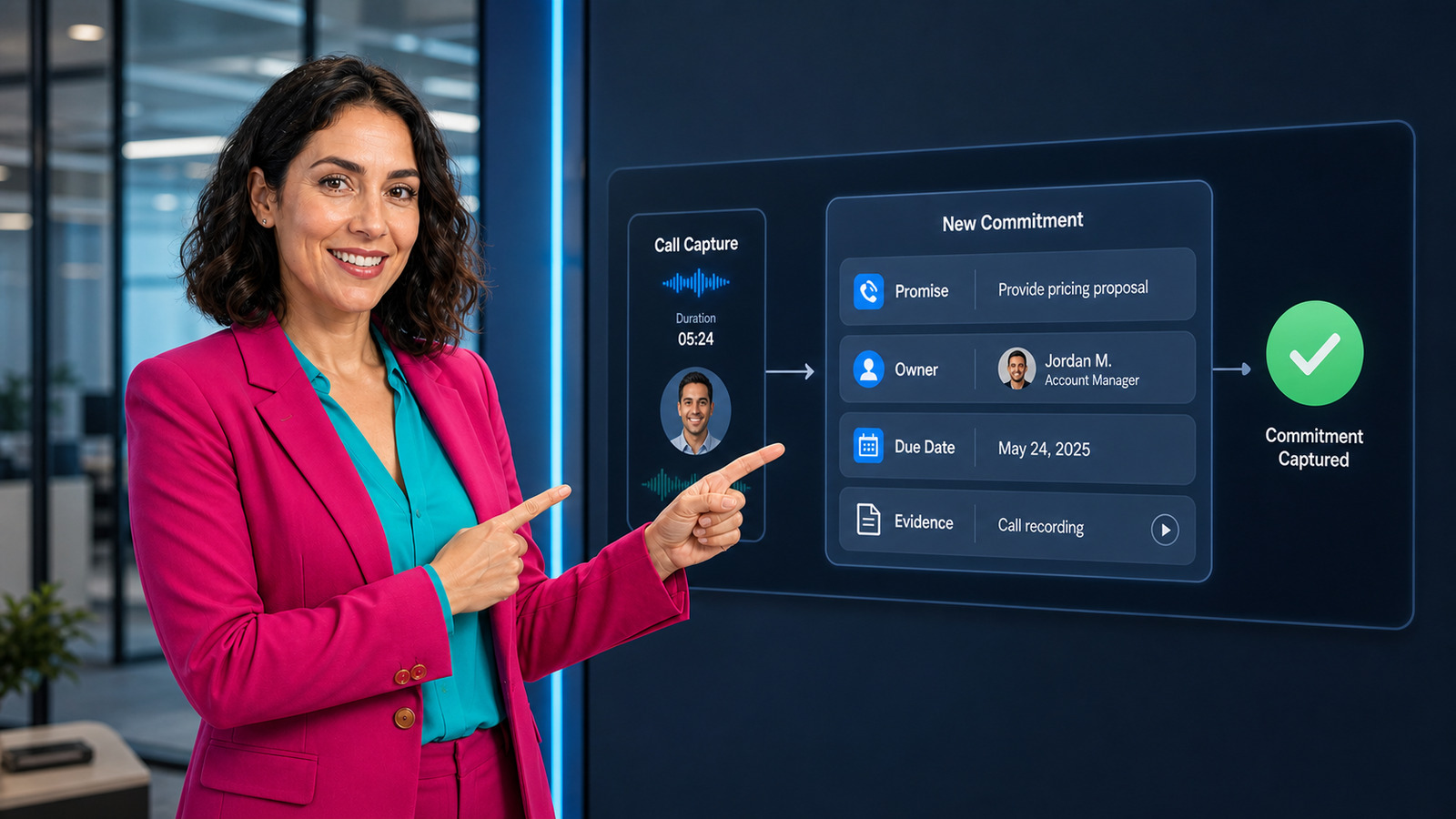
Capture the Promise While Context Is Fresh
A customer commitment is more than a task. It is a statement that one side expects the other to honor: send the revised quote by Thursday, confirm a security answer, share the signed document, schedule the specialist, or resolve a delivery question.
When that promise lives only in meeting notes or one salesperson's inbox, the team cannot see the risk. The customer remembers the commitment, but the next owner may never know it exists.
Create the commitment directly inside the customer record before the conversation loses context. Record the promised outcome, customer stakeholder, internal owner, due date, source interaction, supporting document, dependency, and next customer-facing update.
Separate commitments from ordinary tasks
A task such as “review account” may be internal. A commitment such as “send the approved quote by 3 p.m.” has an external expectation. Mark that difference so reminders, escalation, and reporting reflect the customer impact.
Use the sales discovery workflow to connect buyer needs with clear follow-up. Clean duplicates first with BROSH bulk merge so promises are not split across competing records.
Capture rule: if the customer could reasonably ask “When will I receive it?”, the answer belongs in the CRM with an owner and date.
Define a Commitment That Can Be Verified
Vague promises create false confidence. “Follow up soon” does not say what the customer will receive, who will deliver it, or how completion will be confirmed.
Write commitments as observable outcomes. Replace “check pricing” with “send the approved two-year quote to the procurement lead by Thursday at 15:00.” Replace “handle security” with “upload the completed security response and notify the buyer's reviewer.”
Use six quality fields
- Outcome: the exact result the customer expects.
- Owner: one accountable person, even when several people contribute.
- Due date: a real deadline, not an undated priority.
- Dependency: approval, document, customer input, or another task that can block delivery.
- Evidence: the quote, message, signed file, meeting note, or other proof.
- Confirmation: how the customer or responsible teammate will know the promise is complete.
A 2026 university study of experienced B2B buyers identified dependability and effective information sharing among the central trust drivers in digital selling. Operationally, that means promises should be specific enough to share, inspect, and keep.
Quality rule: a teammate unfamiliar with the call should understand the promise and know how to close it without guessing.


Connect Commitments to Quotes, Approvals, and Documents
Most broken promises are not caused by a forgotten calendar reminder. They fail because the work depends on a quote version, approval, signed agreement, customer document, or specialist answer that is stored somewhere else.
Link the commitment to the exact record that must move. A promised quote should show its current version and approval status. A promised contract should show the signature route. A promised response should identify the missing document or accountable expert.
Make dependencies visible before the deadline
When a commitment depends on another person, give that dependency its own owner and earlier due date. Do not wait until the customer deadline to discover that finance, legal, delivery, or an executive decision is still pending.
Use explicit statuses: captured, accepted, waiting on internal input, waiting on customer input, at risk, completed, customer confirmed, renegotiated, or cancelled. Each active status needs one next action.
The pricing approval CRM workflow shows how to tie a decision to an exact quote version. The invoice-to-cash workflow applies the same discipline to purchase orders, signed documents, and payment readiness.
Dependency rule: a promise is not on track merely because its due date is in the future; every blocking condition must also be visible and owned.
Escalate Exceptions Before Customers Have to Chase
A useful CRM does not wait for a promise to become overdue. It highlights risk while the team still has options.
Trigger an exception when an internal dependency misses its date, a required document is absent, an approval remains idle, the owner changes without acceptance, the customer deadline moves closer, or the next update is no longer credible.
Use a practical escalation ladder
The first alert should go to the commitment owner with the missing evidence. If the risk remains, notify the team lead. Escalate further only when customer impact, revenue exposure, or contractual risk justifies it.
Automation can detect time and status conditions, but a person should decide whether to reassign work, change scope, involve leadership, or renegotiate the promise. If the original date cannot be kept, contact the customer before the deadline with a clear explanation, new date, and owner.
The UK Government's contract-management principles emphasize clear accountability, documented management plans, strong governance, and risk-based oversight. Those principles translate well to everyday B2B commitments, even before a formal contract exists.
For sensitive automation, follow the intelligent CRM automation pattern: trigger, condition, action, human review, and recorded outcome.
Escalation rule: the customer should hear about a credible recovery plan before they need to ask where the promised item is.


Run a Weekly Customer Commitment Review
A commitment review should be short, evidence-based, and focused on action. It is not another pipeline meeting.
Filter active commitments by due date, account value, customer impact, owner, status, and dependency risk. Start with overdue items, then promises due within seven days, then high-value or sensitive accounts whose dependencies are not ready.
Ask five questions for every risk
- What exactly did the customer expect?
- What evidence shows the current status?
- Which dependency is blocking progress?
- Who owns the next action and by when?
- Does the customer need an update or a renegotiated date now?
Close completed commitments only when the evidence exists. A sent file, approved quote, scheduled meeting, signed document, or customer acknowledgement is stronger than an owner clicking “done.”
Use CRM scheduling to keep dated promises visible, and connect unresolved commercial risks to the evidence-based sales forecast.
Review rule: discuss exceptions and decisions, not every green item. Healthy commitments stay visible in the dashboard without consuming meeting time.
Measure Reliability, Not Activity Volume
Counting tasks completed can reward busywork. Commitment management should reveal whether the business keeps the promises customers actually care about.
- On-time commitment rate: customer commitments completed by the agreed date.
- Customer-confirmed completion: closed promises with visible receipt or acceptance.
- Overdue commitments: open promises past their date, segmented by owner and account.
- At-risk lead time: how early the workflow identifies a likely miss.
- Renegotiation rate: commitments whose date or scope changed before expiry.
- Unowned commitment rate: promises without one accountable person.
- Dependency aging: time spent waiting for approvals, documents, or customer input.
- Promise-to-response time: elapsed time from commitment completion to the next buyer signal.
- Revenue at risk: open commercial value attached to overdue or blocked promises.
Review trends by workflow, not just by employee. Repeated misses may expose an approval bottleneck, missing document template, unrealistic quote target, weak handoff, overloaded specialist, or unclear ownership rule.
OECD's 2026 SME evidence warns that digital tools produce uneven gains when businesses adopt technology without complementary process redesign and organizational practices. The commitment dashboard matters only when the team agrees how promises are captured, reviewed, escalated, and closed.
Management rule: use metrics to repair the workflow and coach decisions, not to encourage owners to hide difficult commitments.

Use a Customer Commitment Control Table
Give every stage a clear record, owner action, and closure test.
| Control point | Required CRM evidence | Owner action | Closure evidence |
|---|---|---|---|
| Promise captured | Outcome, customer stakeholder, source interaction | Confirm wording and importance | Dated commitment record |
| Ownership accepted | One accountable person and due date | Accept or reassign promptly | Named owner and timestamp |
| Dependencies checked | Approval, quote, document, specialist, customer input | Create earlier dependency tasks | Ready status or active exception |
| Work in progress | Current status, evidence, next action | Update material changes | Credible path to due date |
| Risk detected | Blocker, customer impact, revenue exposure | Recover, escalate, or renegotiate | New action, owner, and date |
| Promise completed | Sent file, approved quote, signed document, or delivered action | Notify the customer | Delivery evidence |
| Customer confirmed | Receipt, acceptance, response, or agreed next step | Close and schedule follow-up | Confirmation and next action |
Questions and Answers
What is a customer commitment in a B2B CRM?
It is a specific outcome that a customer or teammate reasonably expects by an agreed date, recorded with one owner, supporting evidence, dependencies, status, and a clear completion test.
How is a customer commitment different from a CRM task?
A task may be internal activity. A customer commitment carries an external expectation, such as sending a quote, document, answer, or approval by a promised date. It therefore needs stronger visibility and escalation.
Which fields should a commitment record contain?
Capture the promised outcome, customer stakeholder, accountable owner, due date, source, dependency, linked quote or document, current status, evidence, next action, and customer confirmation.
Who should own a promise that requires several departments?
Name one accountable owner for the customer outcome. Contributors can own dependency tasks, but the main owner remains responsible for coordination, risk escalation, and the customer update.
When should an overdue promise be escalated?
Escalate before the deadline when evidence shows a blocked approval, missing document, rejected handoff, unavailable owner, or unrealistic date. Use customer impact and revenue risk to select the escalation level.
Can customer commitment tracking be automated safely?
Automate capture prompts, completeness checks, reminders, dependency alerts, status-based routing, and dashboards. Keep sensitive customer communication, scope changes, ownership disputes, and renegotiated promises under human review.
Which metrics show whether the team keeps customer promises?
Track on-time completion, customer-confirmed completion, overdue commitments, risk lead time, renegotiations, unowned promises, dependency aging, buyer response time, and revenue attached to blocked commitments.
Turn Trust Into a Repeatable Revenue Workflow
B2B trust is built through many small moments of dependable execution. A complete customer record, explicit promise, named owner, linked quote or document, early risk signal, and visible confirmation turn good intentions into an operating system.
BROSH CRM brings customer records, follow-up, quotes, approvals, documents, tasks, owners, dates, and reporting into one practical workflow. That shared context helps teams keep commitments without relying on memory or inbox archaeology.
Sources: University of New Brunswick, trust in B2B digital selling environments (2026); UK Government, contract management principles (2025); OECD, SME digital tools and process integration (2026).
Ready to make every customer promise visible and accountable?
See how BROSH can connect commitments, quotes, approvals, documents, owners, dates, and follow-up in one CRM workflow.
Talk to a CRM Expert