
B2B quote speed and margin control
Pricing Approval CRM: Send B2B Quotes Faster Without Losing Margin
Replace discount emails, missing quote context, and approval chasing with one evidence-based CRM workflow that protects customer response time and commercial discipline.
Last modified: August 23, 2026

Start With a Complete Quote Request
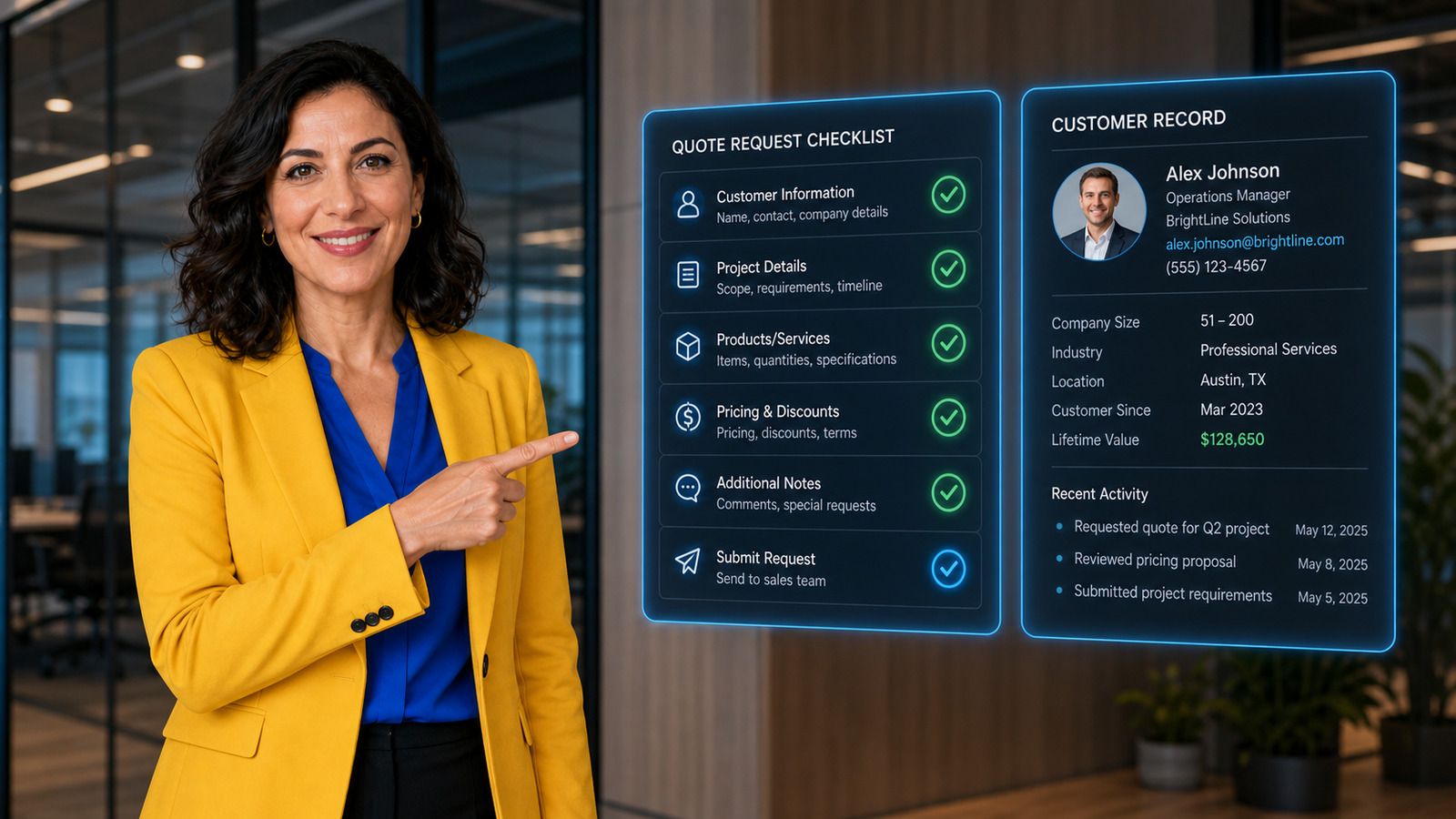
A slow quote often begins before pricing reviews it. The salesperson asks for approval without the current scope, quantity, term, delivery promise, customer entity, tax treatment, payment condition, or reason for an exception. Reviewers then rebuild the deal through chat messages and attachments.
Create a quote request inside the customer record. Require the commercial facts that affect price: products or services, units, contract length, requested start date, current list price, proposed discount, expected margin, delivery cost, payment terms, quote expiry, and the customer outcome the proposal supports.
Link the active contact, account, opportunity, previous quote version, supporting document, and next customer commitment. If a field is unknown, mark it clearly and assign the person who must resolve it. Do not hide uncertainty in free text.
Separate facts from negotiation notes
Facts should be reportable fields with a date and source. Negotiation notes can explain context, but they should not replace the price, discount, term, approval owner, or quote status.
Use CRM with integrated quote signing to keep the commercial record and final document connected. The CRM data hygiene workflow helps prevent old contact and company data from contaminating the request.
Submission rule: an approval clock starts only when the request contains the minimum evidence needed for a responsible decision.
Define Discount Bands Before the Deal Arrives
When every discount is treated as a unique emergency, managers either become a bottleneck or approve exceptions without enough scrutiny. A small B2B team can avoid both outcomes by publishing clear authority bands.
Define the price types a seller may use without review, the discount or margin threshold that needs manager approval, and the circumstances that require finance or executive review. Include non-price concessions such as extended payment terms, free services, custom delivery, cancellation rights, or unusual implementation work.
Use risk, not deal size alone
A large standard renewal may be safer than a smaller quote with low margin, unclear scope, custom work, and long payment terms. Route by the combined commercial risk: discount depth, margin, contract duration, delivery exposure, customer credit, precedent risk, and exception type.
A 2025 peer-reviewed study using more than 500,000 transactions found that salesperson pricing discretion has contingent customer and business effects. That supports a practical middle path: give sellers bounded authority, make exceptions visible, and review the cases where context changes the risk.
Keep the bands simple enough to explain in one page. Show the seller why approval is required, who owns it, which evidence is missing, and what change could return the quote to a standard lane.
Governance rule: delegate routine decisions inside explicit boundaries; escalate exceptions with evidence instead of routing every quote to everyone.


Route Pricing Exceptions Through a Visible Approval Lane
Once the request is complete, the CRM should select the shortest valid approval path. One owner receives the current task; other stakeholders remain informed without creating parallel decisions.
For each approval, show the proposed price, list-price variance, margin effect, customer value, competitive or strategic context, deadline, previous decision, and the exact exception. Reviewers should approve, reject, request specific evidence, or propose a revised condition.
Make decisions traceable
Capture who decided, when, under which policy version, and why. Store the approved terms against the exact quote version. If the seller changes price, scope, payment terms, or contract length after approval, trigger a controlled recheck instead of silently reusing the old decision.
McKinsey's 2026 B2B pricing research describes discount guidance and negotiated-deal scoring for exception approval as practical workflow applications, while also emphasizing integration and change-management barriers. The operational lesson is not to add an opaque tool; it is to connect guidance, evidence, approval, and the customer document in one controlled flow.
Use safer CRM automation for trigger, condition, action, human review, and outcome. Keep sensitive commitments and unusual exceptions with accountable people.
Version rule: approval belongs to a specific quote version and set of terms—not to the opportunity forever.
Keep the Customer-Ready Quote Moving
An internal approval is not the finish line. The customer still needs a clear document, an accountable sender, a response date, and a visible next action.
When approval completes, generate or update the customer-ready quote from the accepted fields. Confirm the legal entity, scope, price, tax, payment terms, validity date, delivery assumptions, signature route, and attachments. Lock or flag fields that would invalidate the approval if changed.
Connect status to ownership
Use explicit statuses such as draft, submitted for review, evidence requested, approved, document prepared, sent, viewed, customer question, revised, signed, declined, or expired. Each active state needs one current owner and a dated action.
Pause automated reminders when the customer replies, requests a revision, asks for more time, or raises a sensitive concern. Route new commercial changes back through the right approval band. Store the final signed document and promised follow-up beside the customer record.
The BROSH guide to rescuing stalled B2B deals shows how evidence and next actions keep momentum visible. For due dates and customer commitments, connect the CRM calendar to the quote status.
Customer rule: every approved quote must answer who sends it, by when, with which version, and what customer response will change the status.


Manage Quote Speed and Margin Together
Fast approval is useful only when it produces accurate, commercially sound customer documents. Margin control is useful only when the process does not make buyers wait unnecessarily. Managers need both sides of the workflow.
- Complete-submission rate: requests entering review with all required evidence.
- Quote turnaround time: from complete request to customer-ready document.
- Time by approval lane: standard, manager, finance, and executive review.
- Evidence-request rate: submissions returned for missing information.
- Exception aging: open exceptions past their decision deadline.
- Discount and margin distribution: by seller, segment, product, and exception type.
- Override rate: proposed terms changed by reviewers.
- Reapproval rate: approved quotes changed before sending.
- Sent-to-response time: elapsed time until the next customer signal.
- Approval-to-sign rate: approved quotes that become signed business.
Review outliers weekly. A slow lane may indicate unclear authority, incomplete requests, unavailable reviewers, excessive approval layers, or a pricing rule that no longer matches the market. A low delay with rising discounts may reveal weak control rather than efficiency.
Connect these measures to the evidence-based sales forecast workflow so managers distinguish approved commercial progress from optimistic pipeline movement.
Launch the Workflow in 30 Days
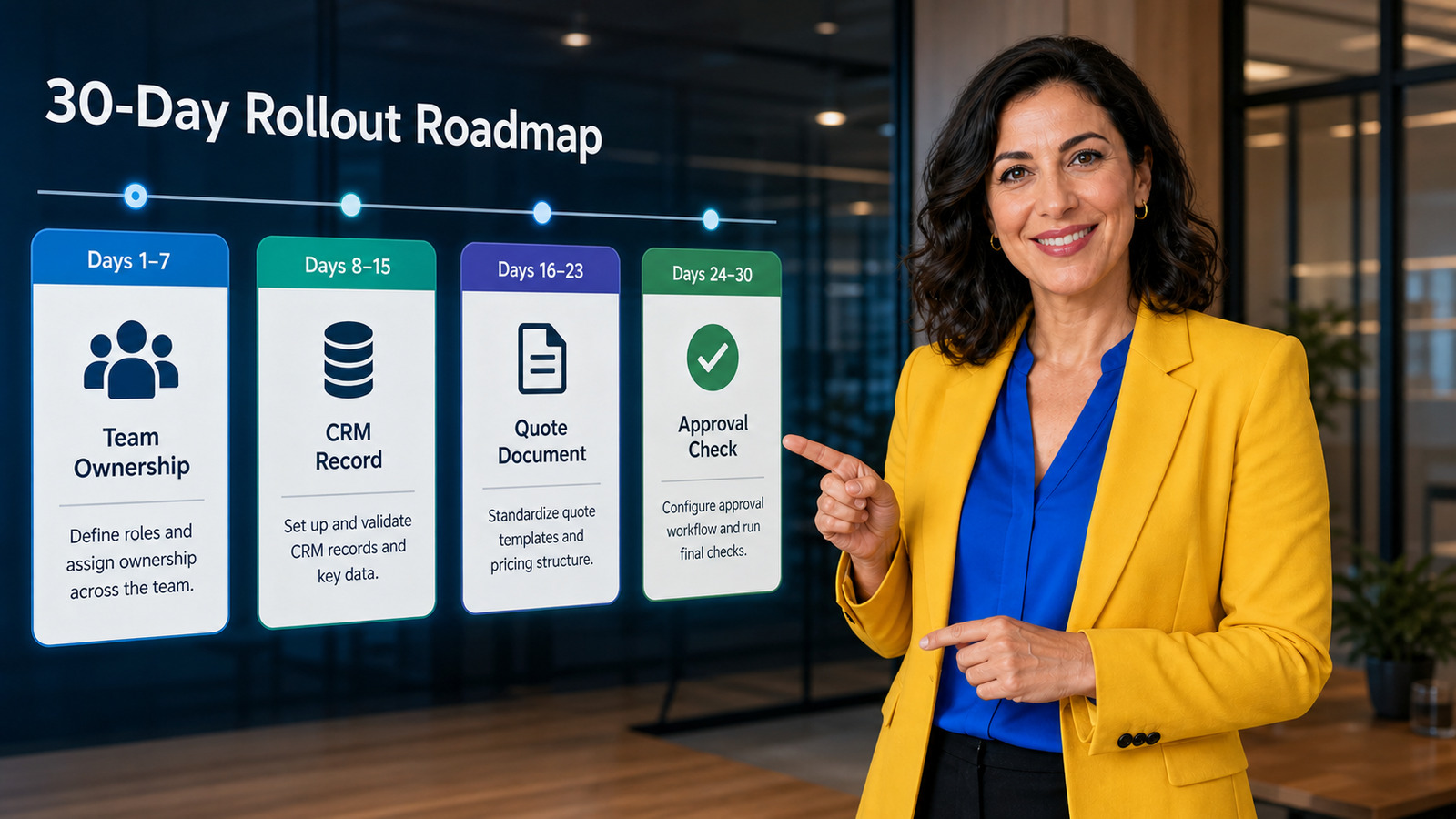
Days 1–7: map the current path
Review recent standard quotes, discounts, rejected requests, revisions, and signed deals. Record where context was missing, who waited, which commitments changed, and where margin or customer momentum was lost.
Days 8–14: define controls
Agree the minimum request fields, authority bands, exception types, response targets, version rules, status values, and ownership model. Choose one segment or quote type for the first rollout.
Days 15–21: configure and test
Build the CRM record, approval tasks, reminders, decision reasons, document links, and reapproval triggers. Replay old quotes through the new path and compare results with the original decisions.
Days 22–30: train and launch
Teach sellers how to submit complete requests and explain exceptions. Teach reviewers how to decide inside the CRM, request precise evidence, and avoid off-system approvals. Monitor turnaround, missing evidence, exception aging, discount distribution, and customer response.
The UK Government's research on technology adoption among small and medium businesses describes adoption as a staged journey and highlights the value of reliable, personalized support. Start narrow, make the workflow useful to the people doing the work, and expand only after the first lane is trusted.
Adoption rule: simplify one high-frequency quote path first; prove speed, clarity, and control before adding more products or approval levels.
Use a Pricing Approval Control Table
Make the expected evidence, owner, and closure condition visible at every control point.
| Control point | Required CRM evidence | Owner action | Closure evidence |
|---|---|---|---|
| Quote request | Customer, scope, quantity, term, price, margin, timing | Seller submits complete record | Submission timestamp and completeness |
| Authority check | Discount band, margin floor, exception type | CRM selects valid lane | Policy version and assigned reviewer |
| Exception review | Business reason, customer value, risk, deadline | Reviewer approves, rejects, or requests evidence | Dated decision and reason |
| Quote version | Approved fields and linked document | Seller prepares customer version | Exact approved version stored |
| Customer send | Sender, recipient, expiry, next action | Owner sends and schedules follow-up | Sent timestamp and status |
| Commercial change | Changed price, scope, term, or payment condition | CRM checks reapproval rule | New approval or documented standard change |
Questions and Answers
What is a pricing approval CRM workflow?
It is a controlled process that connects the customer record, quote facts, discount or margin rules, exception evidence, accountable reviewers, document version, decision history, and customer follow-up.
Which quote fields should B2B teams require before approval?
Require customer and contact, scope, quantity, contract term, list price, proposed price, discount, expected margin, payment terms, delivery assumptions, quote expiry, exception reason, owner, and customer deadline.
How many pricing approval levels should a small B2B team use?
Use the fewest levels that match real risk. Routine terms can stay with sellers, defined exceptions can go to a manager, and only material margin, finance, legal, or precedent risks should require additional review.
When should a quote require reapproval?
Require reapproval when a change moves outside the accepted authority band or materially changes price, discount, margin, scope, payment terms, contract length, delivery exposure, or another controlled condition.
Who owns a quote while approval is pending?
The CRM should show one current task owner for the decision and one commercial owner responsible for customer communication. The seller remains accountable for missing evidence and the customer deadline.
Can pricing approvals be automated safely?
Automate completeness checks, authority routing, reminders, standard calculations, version comparison, and status updates. Keep unusual exceptions, sensitive commitments, and high-risk decisions with accountable human reviewers.
Which metrics show whether pricing approval is working?
Track complete submissions, turnaround time, time by lane, evidence requests, exception aging, discount and margin distribution, overrides, reapprovals, customer response time, and approval-to-sign conversion.
Build a Faster Path From Price Request to Signed Quote
Pricing control should help a B2B team respond with confidence, not trap every proposal in a maze. The practical answer is one customer record, complete quote evidence, clear authority bands, short approval lanes, version control, and owned follow-up.
BROSH CRM gives sales and operations teams one place for contacts, accounts, quotes, documents, approvals, tasks, owners, dates, and pipeline status. That shared context helps protect margin while keeping the buyer's next step moving.
Sources: McKinsey, B2B pricing and exception approval workflows (2026); Journal of the Academy of Marketing Science, salesperson pricing discretion and customer outcomes (2025); UK Department for Business and Trade, technology adoption among SMEs (2025).
Ready to speed up B2B quote approvals without losing control?
See how BROSH can connect customer context, pricing evidence, approvals, quote versions, documents, owners, and follow-up.
Talk to a CRM Expert