
CRM data hygiene for B2B revenue teams
Stop CRM Data Decay Before It Leaks B2B Revenue
Keep customer records, follow-up, quotes, approvals, and documents ready for the next revenue decision.
Last modified by Ben Ford, on Mon Aug 17 2026 00:00:00 GMT-0500 (Central Daylight Time)


Make CRM data fit for purpose
The UK Government Data Quality Framework defines quality as fitness for purpose.
For active CRM records, six checks matter: completeness, uniqueness, consistency, timeliness, validity, and accuracy.
A filled field can still be wrong. A complete record can still be stale. Test the information against the customer decision it must support.
Where stale CRM records create revenue friction
- The real decision-maker waits while sales contacts a former stakeholder.
- Duplicate accounts split emails, tasks, quotes, and documents.
- A sent quote remains marked as draft, hiding the next action.
- An approval or signed agreement stays trapped in email.
One stale fact can delay an otherwise healthy deal.


Treat data quality as ongoing work
A peer-reviewed Data Science Journal article presents quality assessment as a dynamic process shaped by user needs.
- Fix errors at the source.
- Monitor priority records throughout their lifecycle.
- Recheck quality when the customer context changes.
Revenue rule: trust data when it is current enough for the decision in front of the team.
Prioritize records by revenue exposure
A broad cleanup project often fails because the team starts with every field in every record. Begin with accounts where stale information can change an outcome this quarter.
Tier 1: active commercial decisions
Review open opportunities, quotes awaiting response, approval-dependent deals, unsigned documents, overdue buying actions, renewals in the planning window, and customers with an unresolved service issue. These records deserve the strongest freshness rules because a wrong owner, date, stakeholder, or status can delay revenue immediately.
Tier 2: active customers and near-term expansion
Verify account ownership, operational contacts, contract dates, documents, open commitments, and the next planned customer conversation. A clean sales record that becomes incomplete after handoff is not a clean customer record.
Tier 3: dormant and low-intent records
Keep these searchable and compliant, but do not spend the same effort as active revenue work. Use clear last-verified dates and re-verify before a new campaign, qualification attempt, or reactivation sequence.
Define a minimum trusted record
For an active B2B account, the minimum usually includes the legal or trading name, primary contact, stakeholder role, email or phone, accountable owner, lifecycle or opportunity status, next action and date, latest interaction, quote status, relevant approval, current document status, and a last-verified timestamp.
If one person or company appears more than once, start with BROSH's guide to merging duplicate CRM contacts and accounts. Merge only after confirming which record holds the current owner, activities, files, and commercial history.

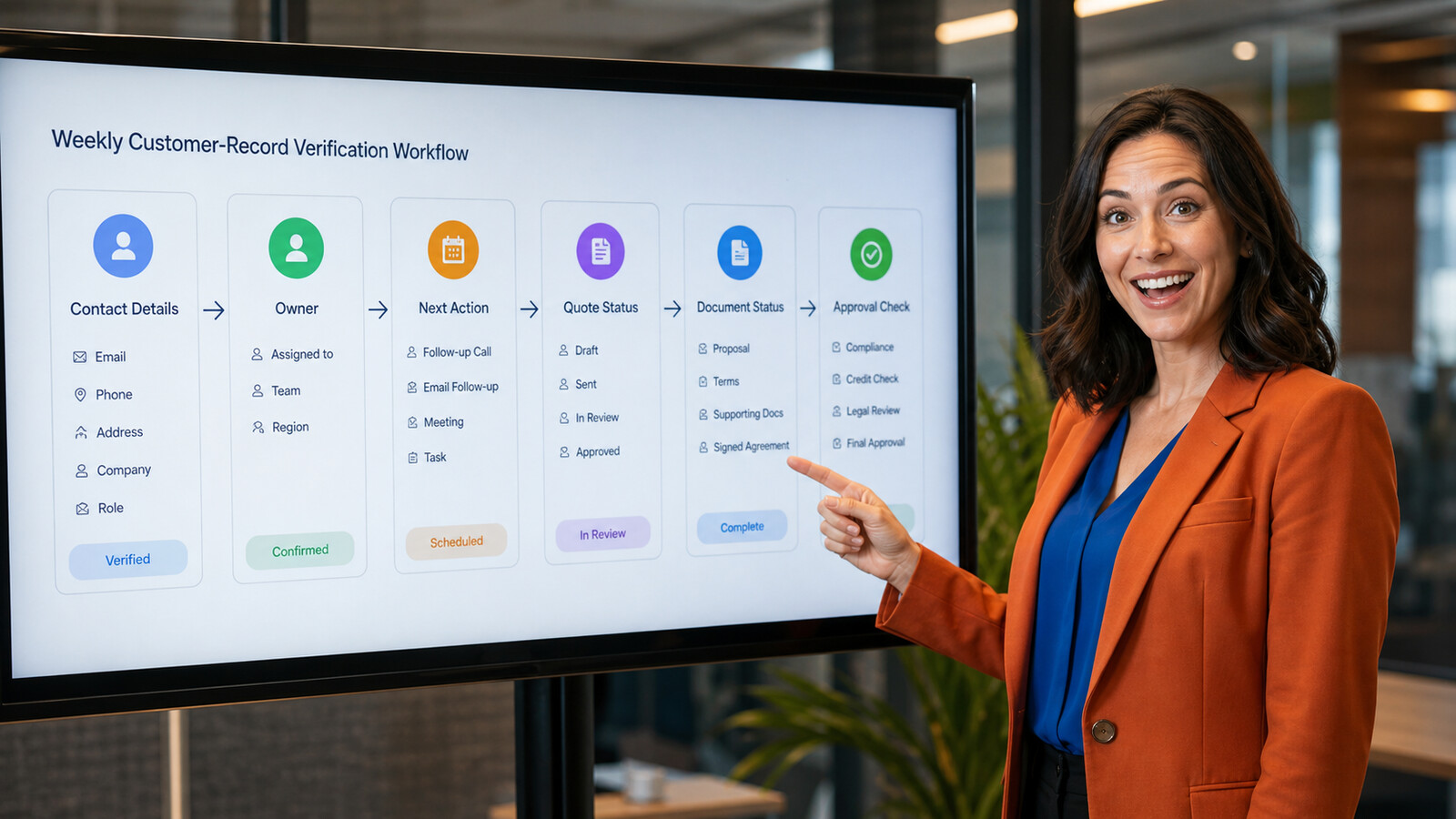
The weekly CRM record verification workflow
Do not clean the database at random. Start with exceptions that can delay a live customer decision.
1. Generate a focused exception queue
Surface active records with no owner, no next action, overdue follow-up, stale contact details, an unclear quote, or an unowned approval.
2. Assign one correction owner
Route each issue to the person closest to the fact. Give the correction a due date and define what proof will close it.
Verify facts, not filled fields
3. Use a current business signal
A recent reply, accepted meeting, approved quote, signed document, or manager decision is evidence. A populated field is not.
4. Correct the record without erasing context
Update the field. Add a short source note. Connect the relevant task or document. Preserve the history that explains why the status changed.


Turn every correction into revenue action
5. Close the commercial loop
If the correction changes a deal, quote, renewal, or customer commitment, create the next action immediately.
Clean data without a dated follow-up is still unfinished revenue work.
Use the BROSH CRM calendar workflow to keep validation dates, quote expiry, approval deadlines, and customer meetings visible.
Verify the fields that change buyer outcomes
| Record element | Verification question | Corrective action | Evidence |
|---|---|---|---|
| Contact and role | Is this person still at the company and involved? | Update role, add replacement, preserve former relationship | Recent reply, meeting, or customer confirmation |
| Account owner | Who is accountable now? | Reassign record and open actions | Manager-approved ownership |
| Next action | Is there a dated customer-facing commitment? | Create a specific task with owner and due date | Accepted meeting or agreed deliverable |
| Opportunity stage | What buyer action supports the stage? | Move stage or record missing evidence | Buyer-confirmed milestone |
| Quote status | Which version is current and who has it? | Archive obsolete drafts; update sent, reviewed, or accepted status | Current quote and customer response |
| Approval | What decision is pending and with whom? | Assign approver and deadline | Recorded decision with conditions |
| Document status | Is the current agreement identifiable and connected? | Attach or link the current file; record signer path | Version, date, and signature status |
| Customer issue | Does an open problem affect trust or timing? | Assign recovery owner and customer update | Customer-validated resolution plan |
Make quote and document truth part of data hygiene
Contact cleaning alone does not protect a deal. A record should show whether a quote is being prepared, awaiting internal approval, sent, under buyer review, revised, accepted, or expired. Documents should have one current version and an owner for the next step. BROSH's built-in e-signature workflow explains how signing status and completed files can remain tied to the customer record.
Use contact capture carefully
Fast capture helps only when new details land in the right account and trigger verification. The BROSH guide to cleaner B2B CRM contact capture shows how captured information can become usable customer context instead of another disconnected record.
Management metrics for trustworthy CRM operations
Measure data quality against live work, not database volume. A 98% completion rate can still hide the one missing approval or wrong stakeholder that blocks an important deal.
- Active-record completeness: percentage of revenue-active records with the required minimum fields.
- Freshness coverage: percentage verified within the time limit set for that workflow tier.
- Ownership coverage: percentage with one accountable owner and no open task assigned to an inactive user.
- Next-action coverage: percentage of active opportunities and customers with a future dated customer action.
- Quote truth: percentage of open quotes with a current version, status, owner, sent date, and next step.
- Document readiness: percentage of relevant records with the current document and signature or review status.
- Duplicate exposure: active pipeline or customer value connected to suspected duplicate records.
- Exception aging: time from a detected issue to a verified correction.
- Reopen rate: percentage of corrected exceptions that fail again within the next review period.
- Revenue at risk: value attached to records missing a critical stakeholder, owner, approval, document, or next action.
A short weekly manager review
Review the oldest high-value exceptions, records whose stage lacks buyer evidence, unowned follow-up, quote and approval bottlenecks, document ambiguity, and repeated failures. End each item with an owner, due date, and proof required to close it.
Good metric design: show which workflow needs attention, not merely that the database contains imperfections.
For the broader operating cadence, see the BROSH guide to practical CRM sales management.


Prepare clean records for useful automation
Automation magnifies the rules already present. Bad ownership and stale stages simply create faster confusion.
Use trigger-condition-action-review rules
Example: a quote has no response for five business days. First confirm the quote and owner. Then create a follow-up task. Finally, require a buyer response or a revised next step.
Protect the fields that drive action
Require critical values, limit status choices, and define each option in plain language. One commercial decision should not be scattered across several conflicting fields.
Keep people responsible for commercial judgment
Rules can flag a missing stakeholder, aging quote, unsigned document, or inactive owner.
People must decide whether the buyer is engaged, which relationship matters, and whether the forecast should change.
Automate detection and routing. Keep customer judgment human-led.

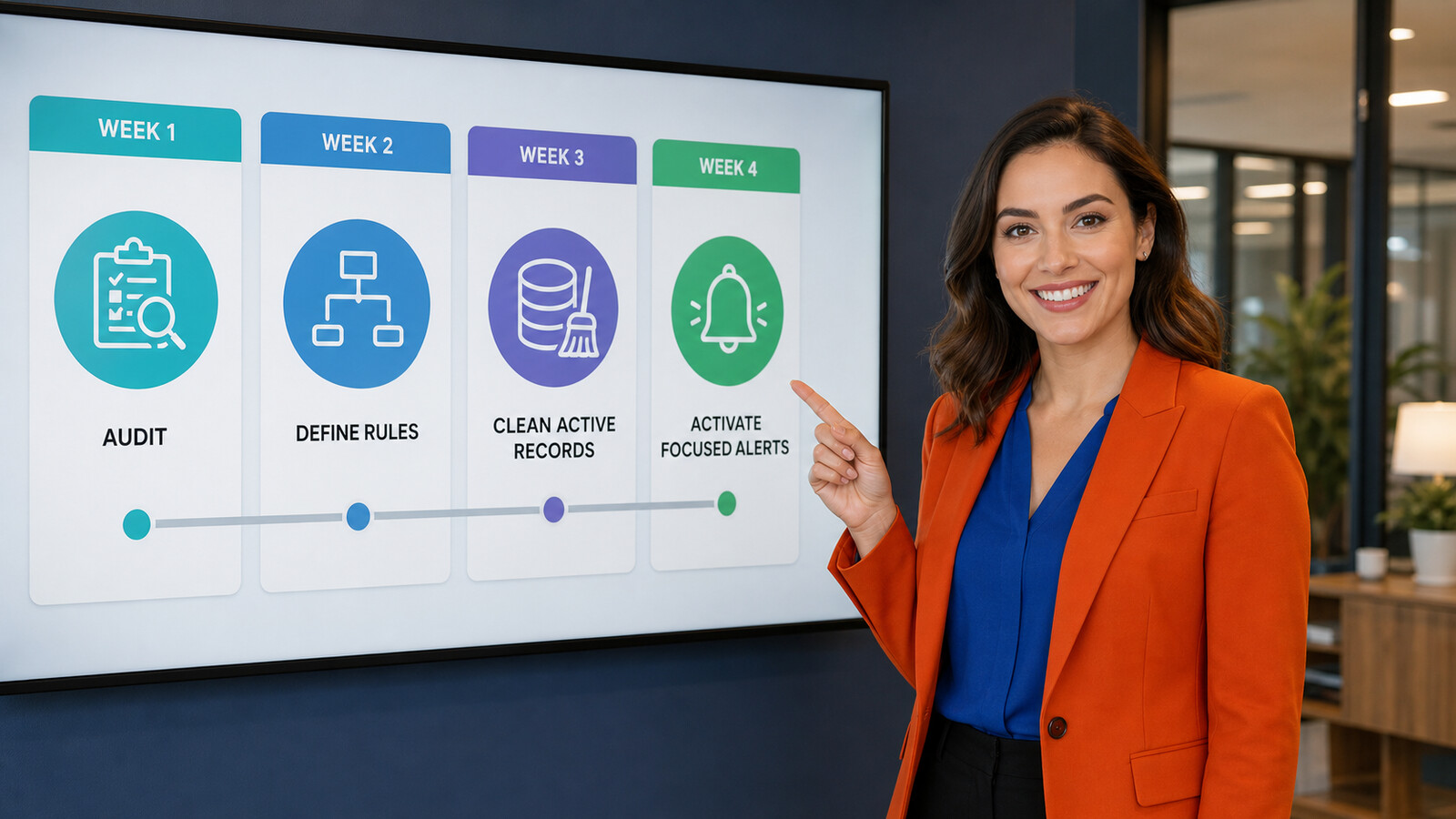
A practical 30-day rollout
- Week 1: inspect wins, losses, delayed quotes, and escalations. Find the first missing fact that made each record unreliable.
- Week 2: define the minimum trusted record, freshness limits, owners, exception reasons, and proof standards.
- Week 3: clean active pipeline and customer records, merge confirmed duplicates, connect current documents, and assign next actions.
- Week 4: activate focused alerts, review exception aging, and remove rules that create noise.
BROSH's guide to safer intelligent CRM automation shows how to automate after the process is trustworthy.
Questions and Answers
How often should a B2B team clean CRM records?
Review revenue-active records weekly and verify critical fields whenever a buyer milestone, owner, quote, approval, or document changes. Lower-priority dormant records can follow a longer schedule and should be re-verified before outreach.
Who owns CRM data quality?
Management owns the rules and accountability, while the person closest to each fact verifies it. Sales should own buyer roles and next steps; operations can own delivery status; finance or management can own approvals; one record owner remains accountable for completeness.
Which CRM fields matter most for sales follow-up?
Prioritize the correct contact and role, accountable owner, opportunity status, last meaningful interaction, specific next action and date, quote status, pending approval, current document, and the customer evidence supporting the next stage.
When should duplicate customer records be merged?
Merge after confirming the records represent the same person or account and deciding which values, activities, tasks, documents, and owner are current. Preserve useful history and verify the merged record before closing the exception.
How should quote status be verified in CRM?
Identify the current version, internal approval, sent date, buyer recipient, review status, requested changes, validity date, and next action. A populated quote field is not enough if the team cannot tell what the buyer has received.
Can CRM data hygiene be automated?
Automate detection, assignment, reminders, validation, and exception reporting after field definitions and ownership are stable. Keep identity confirmation, relationship judgment, commercial status changes, merges, and forecast decisions subject to human review.
Turn cleaner records into faster revenue action
BROSH CRM helps B2B teams connect customer records, owners, follow-up, quotes, approvals, documents, tasks, and management visibility. Make data verification part of the revenue workflow so your team can act with current customer context.
Sources: UK Government Data Quality Framework; Cai and Zhu, The Challenges of Data Quality and Data Quality Assessment in the Big Data Era, Data Science Journal.
Ready to make every active customer record decision-ready?
See how BROSH can connect clean customer data with practical follow-up and revenue ownership.
Talk to a CRM Expert